States Parties to the Nuclear Nonproliferation Treaty (NPT) are currently meeting at the United Nations in New York for the four-week long 2026 NPT Review Conference (April 27 – May 22, 2026).
On May 6, Ambassador Do Hung Viet, President of the NPT Review Conference, released a Zero Draft Outcome Document which, amongst other things, “calls on all nuclear-weapon States to declare that they will not be the first to use nuclear weapons, and to undertake doctrinal and force posture measures to this effect.”
The inclusion of this call in the Zero Draft comes as a result of promotion of no-first-use policies by China (one of the five nuclear-armed States that is a Party to the NPT), the Non-Aligned Movement (which includes 120 member States), legislators from Parliamentarians for Nuclear Non-proliferation and Disarmament (PNND), and civil society organizations that are participating in NoFirstUse Global.
The Zero Draft is a compilation of perspectives and recommendations that have traction at the NPT deliberations. It serves as a basis for negotiating a final outcome document for adoption, following deliberations and negotiations amongst the States Parties to the NPT which continue over the coming two weeks.
Non-Aligned Movement calls for NFU
The Non-Aligned Movement (NAM) member countries that are States Parties to the NPT submitted a working paper to the 2026 NPT Review Conference on Nuclear Disarmament (Working Paper 26) which “calls upon Nuclear Weapon States to commit to a policy of no-first use of nuclear weapons.“
NAM was established during the Cold War to build cooperation on peace, nuclear disarmament and development amongst countries that were not allied to either the Soviet Union or the Western Alliance. It’s membership has grown since the dissolution of the Soviet Union, and it continues to serve as a strong inter-governmental forum on these core issues. 117 NAM countries are members of the NPT. As such, their call for no-first-use comes from a strong majority of States Parties to the NPT.
In response to concerns from some non-NAM States that the promotion of NFU policies might detract from nuclear disarmament, the NAM paper highlights that the adoption of NFU policies should be “an interim measure and not as a substitute to nuclear disarmament.”
China NFU proposal to the NPT
China has maintained a no-first-use policy since becoming a nuclear armed State in 1964. More recently, China has been promoting a No-first-use of Nuclear Weapons Initiative which calls for other nuclear-armed States to also adopt no-first-use policies, and for the N5 (five nuclear armed States in the NPT) to conclude a joint NFU treaty.
In 2024, China submitted a Working Paper on the No-first-use of Nuclear Weapons Initiative to the NPT Prep Com, in which China discusses the security benefits of NFU policies, and calls for the “five nuclear-weapon States to negotiate and conclude a treaty on mutual no-first-use of nuclear weapons, or issue a political statement in this regard.” The paper suggests some elements for consideration in the proposed treaty or declaration.
Some of the other N5 countries have alleged that China’s NFU policy is not credible in light of China’s nuclear weapons policies and practices, including lack of transparency, nuclear weapons build-up and force configuration.
This has prompted a response from a number of policy experts and non-nuclear countries that the call for NFU policies should not be abandoned, but rather that it should be supported, along with the adoption of doctrinal, and force posture measures to give credibility to these policies. This approach is reflected in the Zero Draft Outcome Document released on May 6, 2026 by Ambassador Viet, President of the 2026 NPT Review Conference (paragraph 60).
Examples of measures to give credibility to NFU policies are suggested by Tong Zhao, senior fellow in the Nuclear Policy Program at the Carnegie–Tsinghua Center for Global Policy, in China and the international debate on no first use of nuclear weapons and Youth Fusion interviews Dr Tong Zhao.
Parliamentary and civil society promotion of NFU
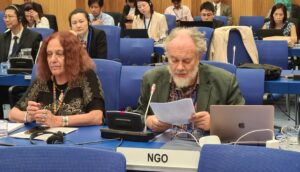
Parliamentarians and civil society organizations promoted NFU policies strongly in the first week of the 2026 NPT review conference including in appeals, statements, a working paper to the NPT plenary, and in side events. These included:
- Side event on April 27 on Reducing the risks of nuclear war: a multi-faceted approach, which included discussion on NFU policies;
- Presentation by Bill Kidd MSP to the NPT plenary on May 1 of the Parliamentary Appeal Turn back the Doomsday Clock which includes a call on nuclear armed and allied states to “phase out the role of nuclear weapons in security policies starting with no-first-use policies”;
- Presentation by John Hallam, NoFirstUse Global core team member, to the NPT plenary on May 1 of Nuclear Taboo: From Norm to Law, which is endorsed by more than 1100 notable individuals and which calls on UN Member States “to ensure their security policies and practices rule-out the initiation of nuclear war including any first-use of nuclear weapons”;
- Presentation by Rebecca Shoot to the NPT plenary on May 1 of the Nuclear Abolition Day Appeal, endorsed by 670 organizations and an additional 1400 notable individuals, which includes a call on nuclear armed and allied States to adopt “policies to never initiate a nuclear war.”
- Working paper to the NPT Review Conference submitted by NoFirstUse Global on No-First Use of Nuclear Weapons: An Exploration of Unilateral, Bilateral and Plurilateral Approaches and their Security, Risk-reduction and Disarmament Implications.
In addition, NoFirstUse Global and Parliamentarians for Nuclear Nonproliferation and Disarmament cosponsored an event on April 7, prior to the NPT Review Conference, on Australia and the Doomsday Clock: Preventing nuclear war, including through NoFirstUse policies which included extensive comments on the importance of NFU policies by Hon Gareth Evans, Former Foreign Minister of Australia and Founder of the Asia-Pacific Leadership Network on Nuclear Nonproliferation and Disarmament.
Risks of first use policies
“A nuclear-armed state that keeps a first-strike option runs the risk of an adversary misreading its intentions and, fearing decapitation, launching a pre-emptive strike, precipitating an otherwise wholly avoidable nuclear war. Again, a nuclear-armed state that fears a surprise first-use attack from another which has kept open that option is more likely to put its forces on extreme launch alert, thereby increasing the risk of human or system error or miscalculation causing a launch that precipitates the very catastrophe it is trying to avert.”
Rt Hon Gareth Evans. Former Foreign Minister of Australia and Founder of the Asia-Pacific Leadership Network on Nuclear Nonproliferation and Disarmament, speaking at Australia and the Doomsday Clock: Preventing nuclear war, including through NoFirstUse policies, April 7, 2026.
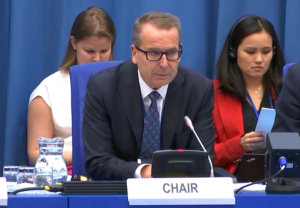
Photo: Ambassador Do Hung Viet, President of the 2026 Nuclear Nonproliferation Treaty Review Conference. UNWebTV.